cinep10
ML / AI Reliability Governance Architecture
The current v0.5 ML/AI structure is not a conventional AI-based prediction system.
The core objective is to govern:
Behavior
↔ Transaction
↔ State
based reliability decisions through:
Calibration
Interpretation
Validation
Governance
In other words, the current ML/AI layer is not:
Prediction-first AI
but rather:
Operational Reliability Governance Layer
Architecture Overview
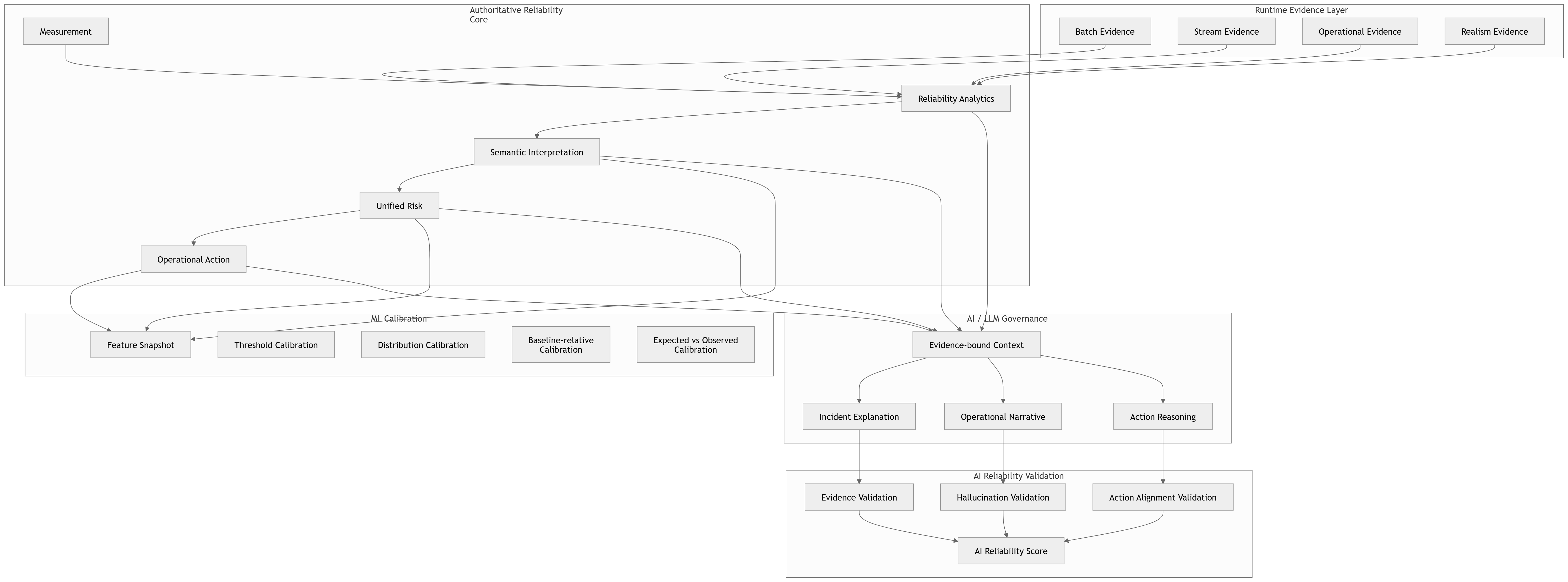
Operational Reliability Core
The authoritative core of the architecture remains:
Measurement
→ Reliability Analytics
→ Semantic Interpretation
→ Unified Risk
→ Operational Action
The key principle is:
ML/AI does not determine final operational risk
Representative authoritative domains:
Behavior ↔ Transaction reconciliation
Transaction ↔ State consistency
Runtime operational evidence
Cross-domain reliability analytics
Operational action recommendation
Runtime Evidence Integration
One of the most important additions in the final v0.5 implementation is the Runtime Evidence integration layer.
The architecture now directly connects:
v0.4 Evidence Layer
→ v0.5 Commerce Reliability Analytics
through integrated runtime evidence structures.
Integrated evidence categories:
Batch Evidence
Stream Evidence
Operational Evidence
Realism Evidence
Representative runtime signals:
runtime_evidence_score
batch_evidence_score
stream_evidence_score
operational_evidence_score
realism_evidence_score
dominant_runtime_signal
The architecture now evaluates not only:
Does the data exist?
but also:
Is the operational environment itself reliable?
ML Calibration Architecture
The current ML layer is not designed as a pure prediction engine.
Instead, it functions as a:
Reliability Calibration Layer
Its purpose is to analyze:
Is the risk/action distribution stable?
Are false escalations occurring?
Is semantic concentration emerging?
Threshold Calibration
Primary purpose:
False Escalation Suppression
Example:
High runtime evidence alone
must not trigger high-risk escalation
This creates a:
measurement-driven calibration structure
Distribution Calibration
Primary purpose:
semantic concentration stabilization
risk distribution stabilization
low/no-action convergence detection
Example:
Coupon Attribution Distortion over-convergence detection
Baseline-relative Calibration
Core philosophy:
absolute anomaly
<
baseline-relative anomaly
Meaning:
Deviation from baseline
is more important than the absolute value itself
Expected vs Observed Calibration
One of the most important additions in the final implementation.
The architecture now compares:
expected semantic/action
vs
observed semantic/action
Primary purpose:
semantic specialization tuning
The calibration layer is therefore not a:
hard failure detection system
but rather a:
review-oriented stabilization framework
Baseline False Escalation Guard
A critical operational stabilization mechanism.
When the system detects:
baseline
+
stable runtime variation
the architecture applies:
semantic escalation suppression
action suppression
Meaning:
baseline-like variation
→ maintain no-action state
AI / LLM Governance Architecture
The AI layer is not a:
free-form reasoning AI
Instead, it functions as an:
Evidence-bound Reliability Governance Layer
The AI layer is only allowed to interpret:
measurement
analytics
semantic
risk
action
runtime evidence
Core principles:
LLM does not directly interpret raw logs
LLM does not overwrite final risk/action decisions
AI Functional Roles
The AI layer performs only the following functions:
Incident Explanation
Operational Narrative
Evidence Summarization
Action Reasoning
Its primary purpose is to explain:
Why is the system risky?
Why was a specific operational action recommended?
AI Reliability Validation
One of the most important architectural principles is:
LLM outputs are also subject to validation
Validation categories include:
Missing Evidence Validation
Unsupported Explanation Validation
Hallucinated Reconciliation Validation
Wrong Operational Recommendation Validation
Meaning:
AI explanations must remain inside authoritative evidence boundaries
PASS_WITH_REVIEW Policy
A critical operational governance policy.
Core principle:
AI validation FAIL
≠
pipeline FAIL
Meaning:
AI explanation review required
must remain separate from:
core reliability failure
Current policy:
AI validation FAIL
+
AI reliability score = review
→ PASS_WITH_REVIEW
This preserves the authoritative reliability engine while requiring human review only for AI explanations.
Replay Reliability Governance
The current ML/AI structure is no longer a simple online prediction architecture.
It already includes:
7-day smoke
14-scenario smoke
30-day pilot
6-month replay
based replay stabilization governance.
The architecture has therefore evolved into:
Operational Replay Reliability Governance
Future ML / AI Expansion
Potential future expansion areas include:
trained model prediction runner
derived ML feature layer
ML output verification
feature importance analysis
AI override guard
LLM execution governance
evidence coverage score
However, the core principles remain unchanged:
ML prediction
≠
Authoritative Risk

LLM explanation
≠
Operational Truth
Final Definition
The current v0.5 ML/AI structure is not simply an AI enhancement layer.
More precisely, it is an:
Measurement
→ Reliability Analytics
→ Semantic Interpretation
→ Unified Risk
→ Operational Action
→ ML Calibration
→ AI Explanation
→ AI Validation
→ AI Reliability Governance
architecture that governs:
Behavior
↔ Transaction
↔ State
based reliability decisions through:
Calibration
Interpretation
Validation
Governance
This is fundamentally an:
Operational ML / AI Reliability Governance Architecture