cinep10
Data Transformation Architecture
The current Transformation Layer is not a simple ETL normalization layer.
The architecture has two primary goals:
1. Transform behavioral data into Batch / Stream / Runtime Evidence
2. Transform Behavior ↔ Transaction ↔ State flows into measurable consistency structures
In other words, the Transformation Layer does not merely normalize data.
Instead, it materializes:
Operational Evidence Structure
+
Cross-domain Consistency Structure
for downstream Reliability Measurement and Analytics.
An important architectural principle is:
Transformation
≠
Measurement
Transformation creates structures that can later be measured.
Actual reconciliation analysis, distortion analysis, and risk interpretation are performed in the Measurement / Analytics Layer.
Transformation Architecture Overview
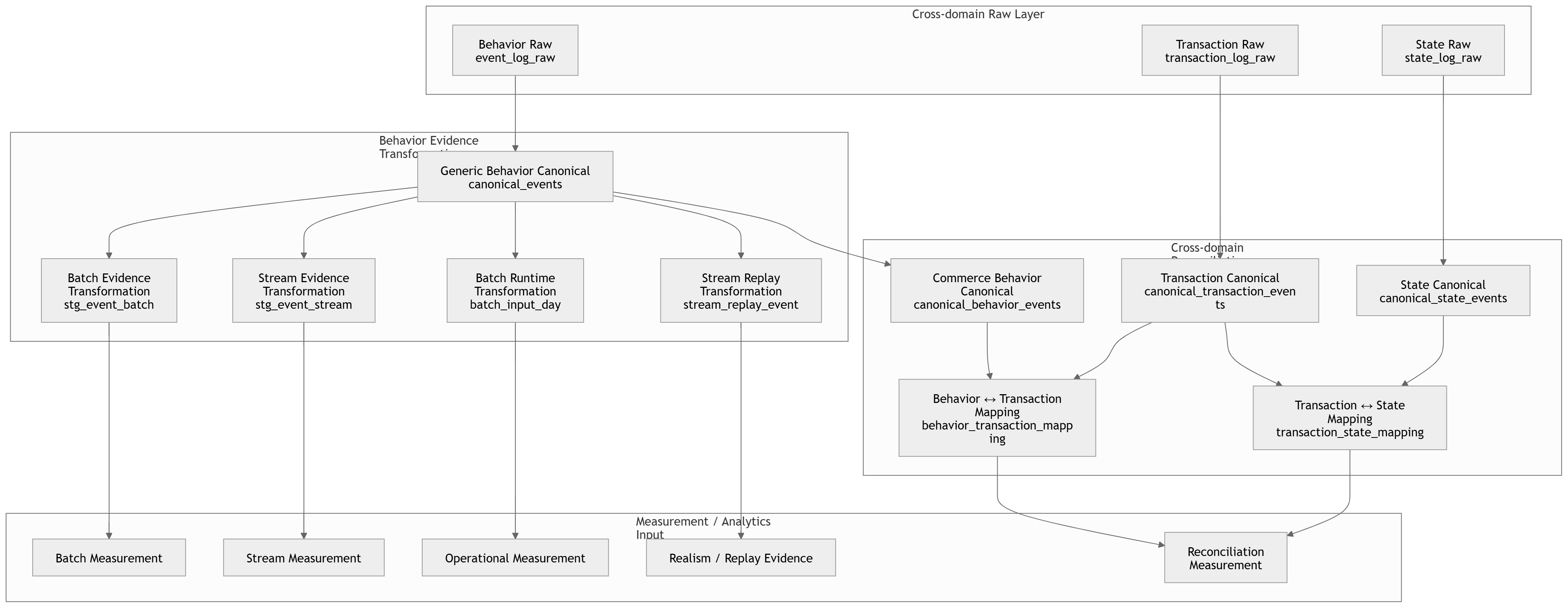
Overall Transformation Structure
The current Transformation Architecture consists of two major layers:
Behavior Evidence Transformation
+
Cross-domain Reconciliation Transformation
The first layer transforms behavioral data itself into operational evidence structures.
The second layer transforms:
Behavior
↔ Transaction
↔ State
into reconciliation-ready consistency structures.
Importantly, this layer still does not calculate risk scores.
Transformation = structure generation
Measurement = consistency observation
Analytics = reliability interpretation
Behavior Evidence Transformation
Behavior Evidence Transformation converts behavioral data into operational evidence structures.
The core flow is:
event_log_raw
→ canonical_events
→ stg_event_batch
→ stg_event_stream
→ batch_input_day
→ stream_replay_event
event_log_raw is the raw behavioral event layer.
Representative events include:
page_view
click
submit
conversion
campaign event
The purpose of this layer is to preserve raw operational behavior evidence.
At this stage:
sessionization
distribution analysis
reconciliation
risk scoring
are not yet performed.
Generic Behavior Canonical
canonical_events acts as the Generic Behavior Canonical Layer.
Its primary role is:
Raw Behavior Event
→ Standardized Operational Event
Representative normalization includes:
visitor normalization
session normalization
event normalization
pageview normalization
conversion normalization
campaign normalization
An important principle is:
canonical_events
≠
risk authority
Instead:
canonical_events
=
generic behavior evidence base
Batch Evidence Transformation
Batch Evidence Transformation converts behavioral data into batch-operational evidence structures.
The actual implementation flow is:
canonical_events
→ stg_event_batch
The goal of this layer is to support:
traffic distribution analysis
campaign distribution analysis
conversion analysis
journey-stage aggregation
visitor/session aggregation
In other words:
Behavior Canonical
→ Batch Operational Evidence
This layer later becomes input for batch analyzers such as:
analyzer_b_v5_v04.py
which generate batch-level measurement evidence.
Stream Evidence Transformation
Stream Evidence Transformation converts behavioral streams into stream-operational evidence structures.
The implementation flow is:
canonical_events
→ stg_event_stream
Additionally, replay-compatible stream reconstruction is supported through:
canonical_events
→ stream_replay_event
The goal of this layer is to support:
stream completeness validation
duplicate detection
late-event validation
ordering validation
producer/consumer parity validation
In other words:
Behavior Stream
→ Stream Operational Evidence
Runtime Evidence Transformation
Runtime Evidence Transformation converts pipeline execution states into operational runtime evidence.
Representative implementation structures include:
batch_input_day
stream_replay_event
The purpose of this layer is to materialize:
batch execution readiness
pipeline availability
stream replay validation
runtime operational evidence
In other words:
Pipeline Runtime
→ Operational Runtime Evidence
Cross-domain Reconciliation Transformation
Cross-domain Reconciliation Transformation is the core of the current v0.5 architecture.
This layer connects:
Behavior
↔ Transaction
↔ State
into reconciliation-ready structures.
The core flow is:
canonical_behavior_events
canonical_transaction_events
canonical_state_events
→ behavior_transaction_mapping
→ transaction_state_mapping
Its purpose is not simple normalization.
Instead, it materializes:
Cross-domain Operational Consistency Structure
Commerce Behavior Canonical
canonical_behavior_events acts as a reconciliation-aware commerce behavior canonical layer.
The key distinction is:
canonical_events
=
generic behavior canonical

canonical_behavior_events
=
commerce reconciliation behavior canonical
Representative identities include:
journey_id
pcid
sid
uid
cart_id
order_id
payment_id
delivery_id
coupon_id
This layer transforms:
Behavior Flow
→ Reconciliation-aware Behavior Evidence
Transaction Canonical Transformation
canonical_transaction_events standardizes business transaction flows.
Representative events include:
order_created
payment_requested
payment_success
coupon_applied
refund_requested
cancel_requested
This layer transforms:
Transaction Flow
→ Business Transaction Canonical
State Canonical Transformation
canonical_state_events standardizes workflow state transitions.
Representative states include:
order_state
payment_state
delivery_state
refund_state
This layer transforms:
Operational Workflow
→ State Canonical Evidence
Behavior ↔ Transaction Mapping
This layer materializes consistency structures between behavior and transaction flows.
Representative implementation table:
behavior_transaction_mapping
The key questions are:
Did behavior lead to transactions?
Do transactions have behavioral provenance?
However, no reconciliation scores are calculated yet.
The purpose of this layer is structure generation for later measurement.
Behavior Flow
+
Transaction Flow
→ Behavior-Transaction Consistency Structure
Transaction ↔ State Mapping
This layer materializes consistency structures between transaction and state-transition flows.
Representative implementation table:
transaction_state_mapping
The key questions are:
Did transactions properly propagate into workflow states?
Do workflow states have valid transaction provenance?
Again, no semantic risk or reconciliation scores are calculated yet.
The purpose is:
Transaction Flow
+
State Transition Flow
→ Transaction-State Consistency Structure
Transformation Boundary
The Transformation Layer performs:
Raw → Canonical normalization
Batch / Stream / Runtime evidence generation
Behavior / Transaction / State linkage generation
Consistency structure materialization
However, it does NOT perform:
reconciliation_gap_score calculation
distortion_score calculation
semantic interpretation
overall_risk_score calculation
recommended_action generation
The Transformation Layer therefore ends at:
stg_event_batch
stg_event_stream
batch_input_day
stream_replay_event
canonical_behavior_events
canonical_transaction_events
canonical_state_events
behavior_transaction_mapping
transaction_state_mapping
Everything beyond this point belongs to the Measurement / Analytics Layer.
Architecture Principles
Transformation ≠ Simple ETL Normalization
Transformation = Operational Evidence Materialization
Separate Behavior Evidence from Reconciliation Structure
Separate Generic Behavior Canonical from Commerce Behavior Canonical
Separate Transformation from Measurement
Final Definition
The current Transformation Architecture is not a conventional ETL transformation layer.
More precisely, it is a:
Behavior Evidence Transformation
+
Behavior ↔ Transaction ↔ State Reconciliation Transformation
architecture.
And more specifically:
It materializes behavioral flows,
transaction flows,
and state-transition flows
into measurable operational evidence structures
and cross-domain consistency structures
for Operational Reliability analysis.