cinep10
Data Ingestion Architecture
The current ingestion layer is not designed as a simple behavioral log ingestion pipeline.
Instead, the architecture focuses on collecting:
Behavior Log
↔ Transaction Log
↔ State Log
as:
Cross-domain Operational Evidence
derived from a single Customer Journey
The ingestion layer is therefore not a conventional ETL ingestion structure.
Instead, it guarantees:
Source Provenance
+
Scenario Identity Propagation
+
Cross-domain Lineage Preservation
+
Replay Reproducibility
within an:
Operational Reliability Collection Architecture
framework.
Collection Architecture Overview
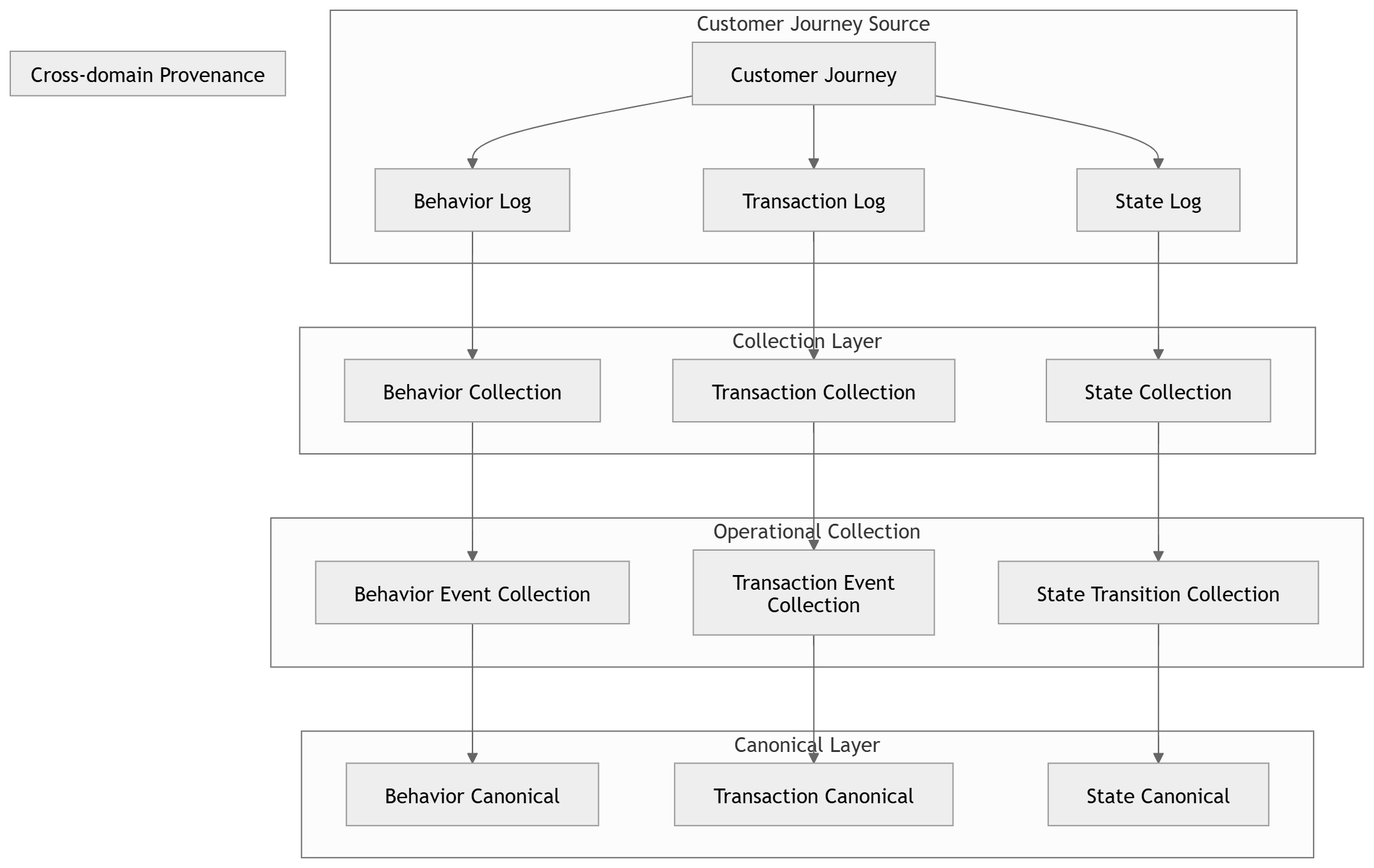
Overall Architecture
The core structure of the current collection architecture is:
Customer Journey
→ Behavior Collection
→ Transaction Collection
→ State Collection
→ Canonical Operational Evidence
The architecture is therefore not limited to:
behavioral log ingestion only
Instead, the system jointly collects:
behavioral flow
+
transaction flow
+
state transition flow
within a:
Cross-domain Operational Collection Architecture
framework.
Customer Journey-driven Collection
The starting point of the collection architecture is:
Customer Journey
Meaning:
Behavior Log
→ Transaction Log
→ State Log
are not independently generated streams.
Instead, they are:
parallel derivatives
from a single customer journey
Example:
restaurant_view
→ menu_click
→ add_cart
→ payment
→ order_created
→ rider_assigned
→ delivered
Within this journey:
behavior logs
transaction logs
state logs
are generated simultaneously.
The architecture therefore becomes:
Journey-aware Collection
Behavior Collection
Behavior Collection handles behavioral log ingestion.
Representative sources:
W3C access log
web event log
behavior event stream
Representative events:
page_view
product_view
click
add_cart
checkout
payment_attempt
Its primary role is:
preserving behavioral flow provenance
Meaning:
Which visitor/session/journey
generated which behavior?
Representative identities:
pcid
sid
uid
journey_id
Transaction Collection
Transaction Collection ingests business transaction events.
Representative sources:
commerce transaction events
payment events
order events
refund events
coupon events
Representative events:
order_created
payment_requested
payment_success
coupon_applied
refund_requested
cancel_requested
Its primary role is:
preserving transaction evidence
connected to behavioral flow
Meaning:
Which business transaction
was generated after which behavior?
Representative identities:
order_id
payment_id
transaction_id
coupon_id
journey_id
State Collection
State Collection ingests operational workflow state transitions.
Representative sources:
delivery state
payment state
refund state
order workflow state
Representative events:
order_confirmed
delivery_assigned
delivered
refund_completed
payment_confirmed
Its primary role is:
preserving operational workflow state
after transactions occur
Meaning:
Did transactions correctly propagate
into operational workflow states?
Representative identities:
delivery_id
refund_id
payment_id
order_id
journey_id
Provenance Preservation
One of the core principles of the current collection architecture is:
all logs are collected
with provenance preservation
Meaning the system preserves:
which source/run/scenario
generated which operational evidence
Representative lineage identifiers:
source_gen_run_id
scenario_id
scenario_name
source_generation_scenario
journey_id
One important architectural principle is:
requested scenario
≠
source generation scenario
Example:
scenario_name = source_identity_drift
source_generation_scenario = baseline
Meaning:
baseline journey preservation
+
runtime anomaly injection
The architecture therefore becomes:
Scenario-aware Collection
Cross-domain Lineage
The current collection architecture preserves lineage across:
Behavior
↔ Transaction
↔ State
This enables downstream reconciliation analysis of:
behavior without transaction
transaction without behavior
state without transaction
Representative linkage identities:
journey_id
order_id
payment_id
delivery_id
coupon_id
refund_id
The architecture therefore becomes:
Cross-domain Operational Lineage Collection
Replay Reproducibility
Replay and reproducibility are fundamental architectural goals.
Meaning:
same date
same scenario
may be executed repeatedly.
Therefore lineage authority cannot rely only on:
scenario_name
Instead, the primary lineage authority is:
source_gen_run_id
This enables:
Replay-compatible Operational Collection
Architecture Principles
The core principles of the current collection architecture are:
Collection ≠ Simple Ingestion
Collection = Operational Provenance Preservation
Behavior ↔ Transaction ↔ State Lineage Preservation
Scenario Identity Propagation Preservation
Replay Reproducibility Preservation
Final Architecture Definition
The current ingestion layer is not a simple ingestion architecture.
More precisely, it is a:
Behavior
↔ Transaction
↔ State
based:
Scenario-aware
Cross-domain Operational Collection Architecture
And more specifically, it guarantees:
Source Provenance
+
Cross-domain Lineage
+
Scenario Identity Propagation
+
Replay Reproducibility
as the:
Operational Reliability Collection Foundation