cinep10
Measurement / Analytics Architecture
The current measurement and analytics layer is not designed as a simple anomaly detection system.
Instead, the architecture focuses on:
Behavior Evidence Measurement
+
Behavior ↔ Transaction ↔ State Reconciliation Measurement
+
Runtime Evidence Integration
+
Measurement-driven Reliability Analytics
The core question is not:
"What scenario was executed?"
but rather:
"What operational inconsistency was actually measured,
and how did it propagate across layers?"
v0.4 measures the instability of behavioral data itself as operational evidence, while v0.5 uses Behavior / Transaction / State consistency as authoritative measurement.
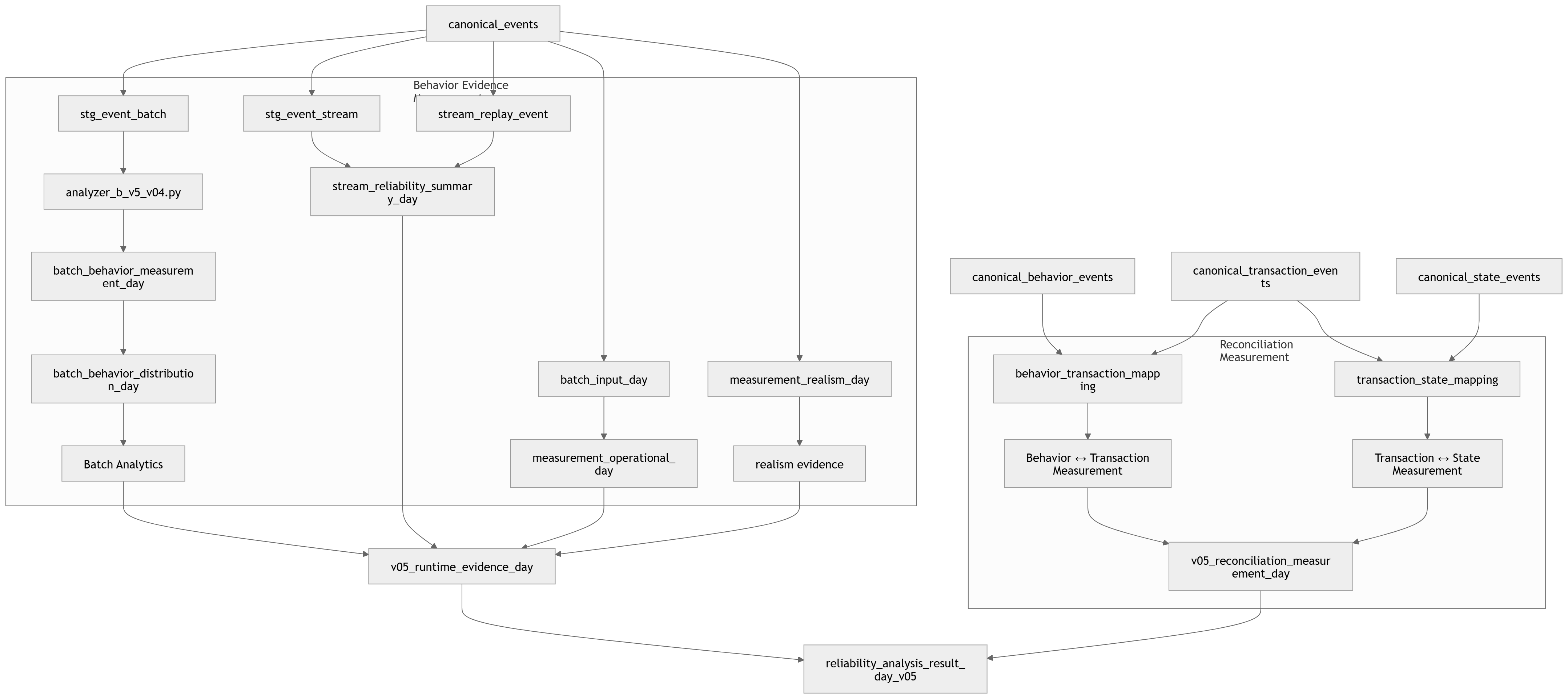
Measurement / Analytics Architecture Overview
Measurement Layer
The measurement layer is divided into two major areas:
Behavior Evidence Measurement
Reconciliation Measurement
Behavior Evidence Measurement evaluates the quality, stability, distribution, and runtime characteristics of behavioral data itself.
Reconciliation Measurement evaluates inconsistencies between:
Behavior
↔ Transaction
↔ State
Behavior Evidence Measurement
Behavior Evidence Measurement evaluates how behavioral data becomes unstable during collection, transformation, and runtime execution.
This layer does not produce authoritative business judgment.
Its role is:
Operational evidence generation
for behavioral data quality and runtime stability
Batch Measurement
Batch Measurement evaluates whether daily behavioral data maintains stable volume, distribution, session structure, and conversion structure.
Overall flow:
canonical_events
→ stg_event_batch
→ analyzer_b_v5_v04.py
→ batch_behavior_measurement_day
→ batch_behavior_distribution_day
analyzer_b_v5_v04.py
analyzer_b_v5_v04.py is the core batch measurement analyzer.
It converts stg_event_batch into operational behavioral measurements.
Primary responsibilities:
identity resolution
sessionization
pageview normalization
conversion measurement
visitor/session aggregation
Identity stitching priority:
uid
→ pcid
→ ip
Session boundaries are created using inactivity thresholds, while pageviews are normalized using:
view_only
logic to prevent system events or click events from inflating behavioral metrics.
Representative measurements:
pageview_count
visit_count
visitor_count
session_count
conversion_count
avg_pageviews_per_visit
avg_session_duration
repeat_visit_count
Batch Measurement therefore evaluates:
Is the behavioral data operationally stable and analytically trustworthy?
rather than simple row counts.
Batch Distribution Measurement
Batch Distribution Measurement evaluates distributional shifts in behavioral data.
Representative dimensions:
event distribution
page distribution
journey stage distribution
campaign distribution
coupon distribution
traffic actor distribution
The goal is not merely detecting volume reduction.
Instead, the system asks:
Which segment, funnel, page,
or campaign became distorted?
For example:
Stable overall traffic
+
decreased checkout/payment events
may indicate funnel distortion rather than generic traffic loss.
Stream Measurement
Stream Measurement evaluates the stability of real-time or near-real-time event flows.
Overall flow:
canonical_events
→ stg_event_stream
→ stream_reliability_summary_day
When Kafka is disabled:
canonical_events
→ stream_replay_event
→ stg_event_stream
When Kafka is enabled:
canonical_events
→ producer
→ consumer
→ stg_event_stream
Representative measurements:
stream completeness
duplicate rate
latency
ordering quality
producer / consumer parity
The objective is:
Can events flow through the stream layer
without loss, duplication, delay,
or ordering distortion?
Operational Measurement
Operational Measurement evaluates pipeline execution quality rather than the data itself.
Representative measurements:
pipeline availability
runtime delay
processing completeness
input/output count
fallback status
Key questions:
Is pipeline execution stable?
Was batch input generated correctly?
Did replay execution complete successfully?
Did runtime latency accumulate?
This layer separates:
data quality
+
execution quality
Realism Measurement
Realism Measurement evaluates whether generated customer journeys resemble realistic operational behavior.
Representative measurements:
pageviews per visit
session duration
repeat visitor ratio
anonymous/authenticated ratio
sid/ip/user-agent stability
non-linear navigation rate
This layer is critical because:
If source behavior itself is unrealistic,
reconciliation measurement loses operational meaning.
Realism Measurement therefore protects downstream analytical validity.
Runtime Evidence Integration
v05_runtime_evidence_day is not a simple intermediate table.
Its role is:
Integrating v0.4 behavioral evidence
into runtime evidence
usable by v0.5 analytics
Inputs include:
batch evidence
stream evidence
operational evidence
realism evidence
Representative scores:
runtime_evidence_score
batch_evidence_score
stream_evidence_score
operational_evidence_score
realism_evidence_score
dominant_runtime_signal
Core principle:
runtime evidence
=
supplementary evidence

reconciliation measurement
=
authoritative measurement
v0.4 explains instability in behavioral evidence itself, while v0.5 explains authoritative business inconsistency between Behavior / Transaction / State.
Reconciliation Measurement
Reconciliation Measurement is the core measurement layer in v0.5.
Measurements are performed from three perspectives:
Behavior ↔ Transaction
Transaction ↔ State
State Timeliness / Orphan State
Behavior ↔ Transaction Measurement
This measurement evaluates whether customer behavior actually resulted in business transactions.
Inputs:
canonical_behavior_events
canonical_transaction_events
Representative keys:
journey_id
order_id
payment_id
cart_id
coupon_id
uid
Representative measurements:
behavior_transaction_match_rate
behavior_only_count
transaction_only_count
Interpretation:
behavior_only_count increase
→ behavior exists without transaction evidence

transaction_only_count increase
→ transaction exists without behavioral evidence
This layer evaluates:
Can behavior and transaction
mutually explain each other?
Transaction ↔ State Measurement
This measurement evaluates whether transaction state transitions occurred correctly.
Inputs:
canonical_transaction_events
canonical_state_events
Representative keys:
transaction_id
order_id
payment_id
delivery_id
refund_id
journey_id
Representative measurements:
transaction_state_match_rate
transaction_without_state_count
orphan_state_count
p95_transaction_state_gap_ms
Interpretation:
transaction_without_state_count increase
→ transaction exists without state transition

orphan_state_count increase
→ state exists without transaction evidence

p95_transaction_state_gap_ms increase
→ delayed state transition
This layer evaluates:
Are transaction workflows operationally consistent?
State Timeliness / Orphan State Measurement
State analysis evaluates more than state existence.
The architecture evaluates:
When did the state occur?
Was it connected to a valid transaction?
Did it violate operational SLA?
Does state exist without transaction evidence?
Representative measurements:
orphan_state_count
transaction_without_state_count
p95_transaction_state_gap_ms
refund_transition_gap
delivery_delay
This layer evaluates:
Can state data reliably explain
the operational workflow?
v05_reconciliation_measurement_day
v05_reconciliation_measurement_day is the authoritative measurement center.
Representative outputs:
behavior_transaction_match_rate
transaction_state_match_rate

behavior_only_count
transaction_only_count
transaction_without_state_count
orphan_state_count

duplicate_order_count
duplicate_payment_count

conversion_gap
payment_order_gap
refund_transition_gap
coupon_reconciliation_gap
p95_transaction_state_gap_ms
This table becomes the direct input to:
reliability_analysis_result_day_v05
Analytics Layer
The analytics layer calculates reliability component scores from measured evidence.
Core principles:
No scenario-name heuristics
Measurement-delta driven
Baseline/noise separation
Runtime evidence as supplementary input
Meaning:
A system is not risky
because the scenario is named "source_partial_missing".

It becomes risky because
actual measurement deltas changed.
reconciliation_gap_score
reconciliation_gap_score measures inconsistency between:
Behavior
↔ Transaction
↔ State
Representative components:
behavior_only_rate
transaction_only_rate
transaction_state_unmatched_rate
orphan_state_rate
transaction_without_state_rate
Methodology:
Convert gap counts into normalized rates
Calculate baseline deviation
Aggregate multiple reconciliation gaps
Meaning:
How severely is operational consistency broken?
propagation_score
propagation_score measures how far source or canonical instability propagated downstream.
Example:
behavior source loss
→ canonical behavior reduction
→ match rate degradation
→ reconciliation gap expansion
Methodology:
source/canonical delta analysis
mapping gap analysis
reconciliation delta analysis
Meaning:
Did upstream instability propagate
into downstream operational inconsistency?
amplification_score
amplification_score measures whether anomalies became amplified through duplication or replay.
Representative inputs:
duplicate_order_count
duplicate_payment_count
stream duplicate rate
replay duplicate evidence
Methodology:
Convert duplicate counts into normalized rates
Compare against baseline duplicate levels
Validate using batch/stream evidence
Meaning:
Did a single anomaly become amplified
through replay or duplication?
distortion_score
distortion_score measures the likelihood of KPI or business interpretation distortion.
Representative inputs:
conversion_gap
payment_order_gap
refund_transition_gap
coupon_reconciliation_gap
delivery_delay
Methodology:
Identify KPI-related gaps
Calculate baseline deviation
Aggregate funnel/payment/refund/coupon distortion
Meaning:
Can operational KPI interpretation become distorted?
transaction_loss_score
transaction_loss_score measures transaction loss or transaction-state disconnection.
Representative inputs:
transaction_only_gap
transaction_without_state_gap
payment_order_gap
transaction_state_unmatched_rate
Methodology:
Validate transaction existence
Validate downstream state transitions
Validate payment/order linkage
Meaning:
Did transactions disappear,
or fail to propagate into operational state?
customer_impact_score
customer_impact_score evaluates impact from the customer journey perspective.
Representative inputs:
behavior gap
transaction_state gap
state delay
delivery delay
coupon/conversion distortion
Methodology:
Connect journey-stage gaps
Evaluate checkout/payment/delivery/refund disruption
Meaning:
Can operational inconsistency
impact customer experience?
runtime_evidence_score
runtime_evidence_score is the supplementary runtime score inherited from v0.4 evidence.
Components:
batch_evidence_score
stream_evidence_score
operational_evidence_score
realism_evidence_score
Methodology:
Batch instability
Stream instability
Pipeline execution instability
Source realism degradation
Important:
runtime_evidence_score
≠
authoritative business risk
Instead, it supplements reconciliation analytics.
Final Architecture Definition
The current measurement and analytics layer is not a simple anomaly detection architecture.
More precisely, it is a:
Behavior Evidence Measurement
+
Behavior-Transaction-State Reconciliation Measurement
+
Runtime Evidence Integration
+
Measurement-driven Reliability Analytics
architecture.
The philosophy is simple:
Measure first.
Analyze second.
Judge using measurement deltas,
not scenario names.
Ultimately, this layer serves as the:
Operational Measurement-to-Analytics Foundation
of the overall Reliability Architecture.